

AltecLansingFan, great link!
I don't know how i've made it this far in life without a USB Helmet Humidifier or Armadillo Breadbin!:laffingassoff:


Originally Posted by Old Guy

Ok?, ok?, but did you already tried these, this is also a big improvement for your system: I can't believe someone makes... 24 carat gold plated fuses (Made By Monkeys)
No? :laffingassoff:

AltecLansingFan, great link!
I don't know how i've made it this far in life without a USB Helmet Humidifier or Armadillo Breadbin!:laffingassoff:
Not all vegetables make good leaders.
I wonder if shielded wiring for power distribution is common in Europe. I was reading about some home built speaker cables online....... I think it was the 6moons website. The article talked of using shielded wire that I believe was purchased bulk, from a non-audio source, and used for power distribution like it was something common. European plumbing is done quite a bit different, too.
Audio_by_Goodwill
Michigan, USA


Having worked in Europe, at least in UK and France, no, shielded power cable is not the norm.
I still haven't heard any explanation how a few feet of power cable is going to make any difference to electricity that has traveled thru miles of ordinary copper. Or in many modern cases, aluminum.
Your neighbors called. They like your music.
Do you mean 380 Volt is common in Europe?
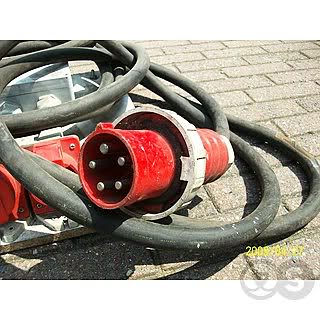
Yes cables and plugs like these are very common, but not for audio systems.
No, I'm just talking about the wire used in walls and cords for general power use. It's my understanding that the voltage is roughly twice the US voltage of 120volts........ and 50hz instead of 60hz.
Audio_by_Goodwill
Michigan, USA
You have 220 or so coming into your house. It splits into two 110 circuits. In my listening room the 220 goes to the room and splits there.
Not a big deal. 220 will kill you a little quicker is the logic America uses. A little silly, but it's how we do it.
i work around 220 all the time.
Your neighbors called. They like your music.
It's actually 240 and 120 now. I'm not sure when the change happened, Though.
How/Why do you have both hots splitting in your listening room? Certainly you could have a 240 outlet in your listening room, but I'm not sure its code to split 120 circuits off of it.
Audio_by_Goodwill
Michigan, USA

I am surprised that any audible change attributed to the use of 'improved' speaker cables can be heard over the enviromental noise floor level which is relatively high in towns and cities. If it can be heard, then surely it can be measured with a laboratory quality spectrum analyser.
Does anyone know of such a test being used for cable comparison? :doh:
Cheers, Marshall.
I just watched the video and it flies in the face of my training. Just for yucks, I performed the same demo on a 2 meter, 14 awg lamp cord cable. WaveTek signal generator, Samson S170 amp, 35mHz dual trace scope. My difference beam showed no ticks with the 2 kHz square wave signal at 1v P-2-P and the difference beam set to 1mV / cm.
---
14 awg NM-2 house cable had the same non results.
---
50 ohm co-ax is RG-8 and the 50 ohm impedance is for RF, not audio, in the 100 to 900 mHz range.
---
To view any cable as a transmission line, it's length should exceed 1/10 of a wave length. The speed of electricity is about 90% the speed of light (~10**9 feet per second) divide that by 100 kHz (10**5) and that by 10 (for 1/10 wave length, we get 1000 feet as a minimum length for serious consideration as a transmission line. Anybody that has speaker cables over a 1000', has more serious problems than transmission line considerations.
---
If anybody was actually serious about cable "transmission line" characteristics, we would see SWR (Standing Wave Ratio) and radiation pattern graphs from the marketing department. For those who care, transmission loss is antenna gain <http://k9erg.tripod.com/theory.htm> The Smoke and Mirrors comment applies.
---
When discussing Altec speaker stacks, passive crossovers cause more and worse acoustic artefacts than inadaquate cables. The great thing about Altec drivers is the large Bl factor. If you think of a driver as a motor / generator set, you would expect a large back EMF (Electro Motive Force) as a consequence of the restorative energy released by the large voice coil moving through the intense magnetic field. The degree that the amplifier feels this EMF voltage is it's damping factor. The reactive and resistive components of the passive crossover (and wiring) destroy this back-EMF coupling.
---
To demonstrate the superior back-EMF generating capabilities (in the aerly 1970's) I hooked up an Altec 515B to a servo amplifier. The driver was facing up (no cabinet), protected with plastic wrap, and sand was piled into it. I stopped at 2 lbs. The amp (1000 watts of DC) was getting hot, and the 515B was slowly giving way to gravity. I stopped the experiment after about 5 seconds. But think, almost 2 lbs of constant thrust. I've tried this with other speakers and the presence or absence of the amplifier made no difference, they just caved in. Granted this demo is about as relevant as Townsend's. Nobody cares about the 0 Hz responce of their sound system. FYI. The Samson 'S' series of amplifiers are servo and despite my BS demo, Altec drivers really do work well with direct coupled servo amps. The early Cinirama systems worked this way.
---
What is a servo amplifier? It compares the back-EMF voltage with the reference voltage (input) and generates as much current as needed to bring the two into allignment. The power output of a servo has nothing to do with it's input. Only the error voltage is inverted and amplified. Example: when an electric motor comes up to speed, it's current draw is sharply reduced. Ideally, the back-EMF equalls the amplifier output voltage, so no current is required to correct the motor or driver. A small 1/2 ohm resistor (actually one of those glass Buss fuses) in series with the driver is used to measure the difference.
---
It would be so neat to have the amplifier integrated into the voice coil - the power leads would have 0 length.
---
Have you ever looked at the wiring inside the cabinet? Or the wiring between the driver terminals and the voice coil? Even Altec's? The use of Monster cables is like wrapping a Ferrari body around a Briggs and Stratton lawn mower engine. They are well made, but ...
 Posting Permissions
Bookmarks